
Farmacia Corradini D’Elia — homepageAll instructions

GUIDE GAL-01 · 28 SEPTEMBER 2026

Your compounded preparation:
how to read the label

Before use, identify the amount to use, the route of administration and the use-by date.

Demonstration labels: names are blank and no amounts to take, frequency or treatment duration are specified. Do not use these examples as treatment instructions.

101 seconds · Arrows and magnified views · Synthetic Italian narration. The video explains the black and red bands, the “Posologia” field and where to find the amount, frequency and treatment duration. Full transcript below.

Lines to check

  1. 1

    Recipient and doctor

    The “Sig.” and “Dott.” lines
    They are blank in the photograph. The video shows where to look without adding names.

  2. 2

    Composition and dose

    20 mg per capsule; 30 capsules in total
    The content per unit does not indicate how many capsules to take each time or how often.

  3. 3

    Route of administration and dosage instructions

    Black band: internal use. Red band: external use.
    The band is in the same position, at the top right.
    “USO INTERNO” (internal use) · “Posologia: secondo indicazione medica” (dosage: as directed by your doctor)
    Look for the amount, frequency and duration in your doctor’s instructions: on the prescription and label, or in other documents provided.

  4. 4

    Use-by date

    “UTILIZZARE ENTRO” (use by) — 27/03/27
    In this example, it means 27 March 2027. It is not the “Prep. del” preparation date and does not indicate treatment duration.

The label is used here to show where the fields are located. This guide does not validate the formula or the printed use-by date.

THE WRITTEN GUIDE

Read this even after watching the video

Check that you have the right preparation

Read the medicine name and, where present, the recipient’s name. Also check its form: capsules, oral liquids, lotions and creams are not used in the same way. Read the instructions again with every new supply, even when the medicine name appears to be the same as before.

Concentration and dose are not the same

Concentration describes how much active ingredient the preparation contains. Dose indicates how much to take or apply each time. Milligrams (mg) and millilitres (mL) are not interchangeable: the former measure mass, the latter volume. If you are unsure how much to measure with the device, ask the pharmacy to demonstrate; do not guess conversions. [1]

Where and when to use it

On our pharmacy’s labels, the black band at the top right indicates internal use. Forexternal use, a band in the same position is red. Check the colour and always read the route of administration and instructions for use as well.

Look for the route of administration and instructions: by mouth, on the skin or at another specified site. Identify the amount for each administration, the frequency and any relation to meals. Wording such as “external use” does not mean a product is to be swallowed.

Dosage instructions: how much medicine and for how long
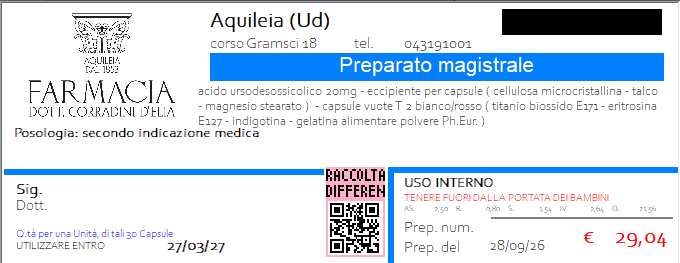
Demonstration label stating “Posologia: secondo indicazione medica” (dosage: as directed by your doctor). No amount, frequency or treatment duration is specified.
The example reads “Posologia: secondo indicazione medica” (dosage: as directed by your doctor).

Dosage instructions state how much medicine to take each time, how often and for how long. When the doctor writes these instructions explicitly on the prescription, they are copied onto the preparation’s label.

If they are not on the prescription but appear in other documentation provided by the doctor, find them in that document and follow them. “As directed by your doctor” refers to your doctor’s individual instructions: by itself, it specifies no amount, frequency or duration.

If you cannot find this information or the documents give different instructions, ask your doctor or pharmacist for clarification before use. Do not infer the dosage from the concentration, total number of capsules or use-by date.

Use-by date and treatment duration

The use-by date indicates how long the preparation may be used under the specified conditions. It does not state how many days your treatment should last. A period after opening does not extend the date on the container: ask the pharmacy which limit applies. Do not use a preparation beyond the stated date. [2]

Microbiological shelf life and physicochemical stability

Microbiological shelf life indicates the period during which appropriate microbiological quality is expected to be maintained, considering bacteria, yeasts and moulds and following the conditions for use and storage. It is not a guarantee of sterility or complete protection against contamination. [5]

Physicochemical stability concerns preservation of the amount and integrity of active ingredients and the preparation’s physical properties needed for correct use. It is assessed using studies and scientific data, including international literature, relevant to the specific formula, concentration, packaging and storage conditions. [6][9]

A medicine may still look “fine” even though its active ingredients have degraded, potentially reducing effectiveness. Contamination may also be invisible: a normal appearance, colour and smell do not guarantee activity or safety. [7][8]

The use-by date must account for both aspects and the strictest applicable limit. Always follow it, along with any instructions after opening: do not extend use because the preparation appears unchanged. [9]

When to contact the pharmacy

Ask for clarification immediately if the label is illegible, a necessary instruction is missing, or the prescription, label and explanations seem to differ. Have the container and preparation identifier, if present, to hand.

Remember: Do not infer the dose from concentration alone or from your memory of a previous pack.

This guide explains general technique. The dose, frequency, duration and precautions for your preparation are those agreed with your doctor and pharmacist. If instructions conflict, ask for clarification immediately; do not change them yourself.

Is any information unclear?

Have the container to hand and ask the pharmacy for clarification before use.

Call the pharmacy · 0431 91001
Full video transcript

1. How to read the label
Compounding at home. Here is how to read your preparation’s label in four steps.

2. Who should use the preparation?
On the “Signor” line, check the recipient’s name. This field is blank in the example image.

3. Who prescribed the preparation?
On the “Dottore” line, check the prescribing doctor’s name. This field is also blank here.

4. How much active ingredient is in one capsule?
Read the active ingredient and amount. Here: ursodeoxycholic acid, twenty milligrams. “Quantity per unit” refers to one capsule.

5. The prepared quantity is not the dose
Thirty capsules is the total prepared, not the dose. The content per capsule does not tell you how many to take or when.

6. Black or red band: check the type of use
On our pharmacy’s labels, the black band at the top right indicates internal use. For external use, a red band appears in the same position. Check the band’s colour and always read the route of administration and instructions for use as well.

7. How much, when and for how long
Dosage instructions state how much medicine to take each time, how often and for how long. When the doctor writes these instructions explicitly on the prescription, they are included on the label.

8. “As directed by your doctor”: where to look
The example reads: dosage, as directed by your doctor. If amount, frequency and duration are not on the prescription but in other documents provided by the doctor, look there. If you cannot find them or they differ between documents, ask your doctor or pharmacist before use.

9. Until when can you use it?
Look for “Utilizzare entro” (use by). In the example: twenty-seven March two thousand and twenty-seven. Do not confuse it with the preparation date and do not use the preparation beyond the stated limit.

10. Unsure? Ask the pharmacy
The use-by date is not the treatment duration. If information is missing, ask the pharmacy before use.

Example label without annotations
Demonstration label with “Posologia: secondo indicazione medica”; blank “Sig.” and “Dott.” fields, ursodeoxycholic acid 20 mg per capsule, 30 capsules total, internal use and a use-by date of 27 March 2027.

Demonstration label supplied by the pharmacy. The recipient and doctor fields are blank.

Sources and revision notes

General sources consulted on 28 September 2026; they do not replace the laboratory’s assessment of an individual preparation.

  1. ISMP / Consumer Med Safety — Liquid Medicines

    Appropriate measuring device, dose measurement and demonstration by the pharmacist.

  2. Healthdirect Australia — Out-of-date medicines

    Following the label’s date and specific storage conditions. No numerical shelf life from the source is applied to Italian compounded preparations.

  3. Istituto Superiore di Sanità — Individually compounded pharmaceutical preparations

    Identifying label fields: prescriber, composition, type of use and dates.

  4. AIFA — Medicines: why respecting the expiry date matters

    Following the time limit and storage conditions; this does not validate the date shown in the photograph.

  5. USP — Chapter 1111: Microbiological Examination of Nonsterile Products

    Public preview: microbiological quality of non-sterile preparations; contamination can affect activity and health. No claim of sterility or complete absence of microorganisms is made.

  6. USP — Compounded Preparation Monographs

    Monographs for specific preparations: formula, stability studies, analytical methods, packaging and storage. The publicly indexed text was consulted; the full page was not accessible during this review. No specific monograph was used to validate the example.

  7. AIFA — Medicines and summer: AIFA’s twenty-point guide

    Appearance, smell and colour do not necessarily reveal deterioration. General shelf-life guidance is not transferred to compounded preparations.

  8. FDA — Don’t Be Tempted to Use Expired Medicines

    Chemical degradation, possible loss of potency and microbiological risk. This reference does not imply that every medicine becomes completely inactive on its use-by date.

  9. EMA — Quality of medicines: questions and answers, Part 2

    The section on shelf life after opening distinguishes physicochemical and microbiological data and considers the shorter limit. It is used for the scientific principle, not as a numerical rule or national standard for compounded preparations.

Text updated on 28 September 2026. The video illustrates the label fields; further information on microbiological shelf life and physicochemical stability is in the written guide. This guide assigns no doses, frequencies or storage periods to the example preparation.